

DIPROM pushes Thai agro-industry to overcome production limitations, leveraging smart technology to reduce costs and labor dependency, while unlocking new opportunities in the export of agricultural products and agro-industrial goods.
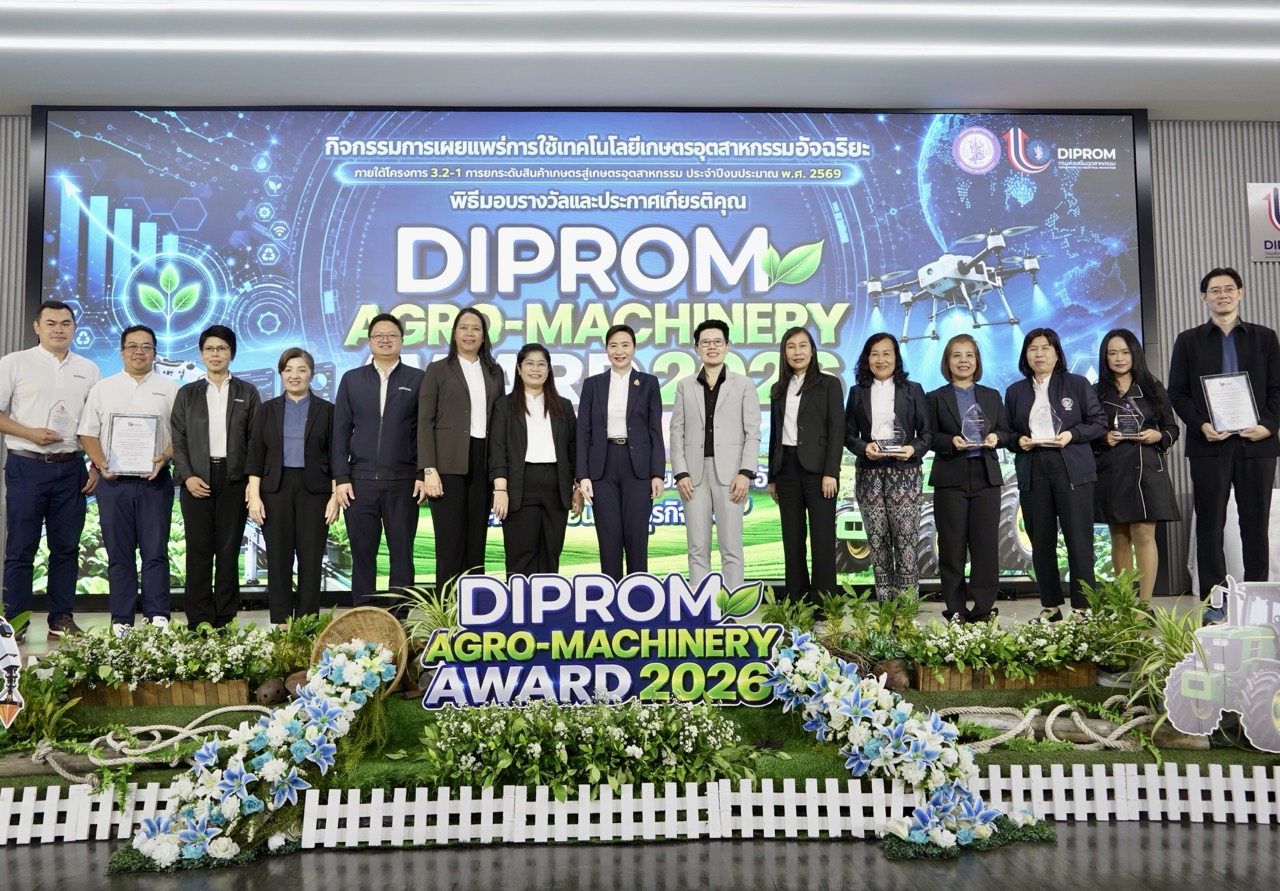
The department also introduces the “DIPROM Agro-Machinery Award 2026,” showcasing five prototype technologies developed by Thai SMEs.
The Department of Industrial Promotion (DIPROM) under the Ministry of Industry is advancing the Thai agro-industrial sector by enhancing production efficiency and adding value to agricultural products. Through the “DIPROM ITC” mechanism, the department facilitates access to and the adoption of machinery, automation, AI, and digital technologies. It fosters collaboration among technology developers, academic institutions, and the private sector to create machinery and innovations tailored to specific types of agricultural produce. The “DIPROM Agro-Machinery Award 2026” serves as a platform to unveil smart agro-industrial technology prototypes, with awards presented to five outstanding innovations—ranging from moisture-reduction systems and AI-based livestock monitoring to produce sorting, IoT-controlled systems, and smart packaging machinery. These initiatives support the development and testing of prototype machinery before they are scaled for commercial use, ultimately boosting the productivity and competitiveness of Thailand’s agro-industrial sector.
Ms. Nattiya Netayasupa, Director-General of the Department of Industrial Promotion, stated that the agro-industrial sector serves as a vital economic driver—generating export revenue, increasing the value of agricultural produce, and strengthening entrepreneurs throughout the entire production supply chain. According to data from the Office of Trade Policy and Strategy under the Ministry of Commerce, Thailand’s exports of agricultural and agro-industrial products reached a total value of over 1.7 trillion baht in 2025. This figure reflects the country’s economic potential and the opportunities available to transform raw materials into value-added processed goods. Nevertheless, entrepreneurs continue to face challenges related to production costs, raw material sourcing, and workforce management. Consequently, it is essential to enhance production processes to ensure long-term efficiency and competitiveness. This can be achieved by upgrading production systems with appropriate machinery and technology, thereby boosting output capacity, minimizing waste, and maintaining product quality standards.
Furthermore, DIPROM aims to foster collaboration among entrepreneurs, technology developers, academic institutions, and the private sector to jointly develop machinery tailored to the specific raw materials and production processes of various agricultural products—covering everything from raw material handling, processing, and sorting to quality control. In line with this, DIPROM organized the “DIPROM Agro-Machinery Award 2026” as part of an initiative to elevate agricultural products into the agro-industrial sector for the 2026 fiscal year. This platform serves to promote and showcase prototypes of smart agro-industrial technologies. Five winning entries were selected, each distinguished by its ability to overcome specific production bottlenecks: The first-place winner, “Smart Air-Drying Technology for *Kuay Jap* (rolled rice noodle) Strips” by the Faculty of Engineering at Ubon Ratchathani University, reduced the drying time from 47.5 minutes to 40 minutes per cycle—an improvement of 15.79%. The first runner-up, an “AI-Powered Cattle Monitoring and Data-Logging System (integrated with Google Sheets)” by K.P.S. Automation and Service Co., Ltd., reduced the manual labor required for monitoring and recording data from 12 hours to just 2 hours, while increasing data tracking accuracy to 90%. The second runner-up was an “Automated Pomelo Sorting Machine Based on Weight” developed by Nakhon Sawan Rajabhat University. It is capable of sorting produce with 98% accuracy and handling a throughput of 800 units per hour. The “Technical Challenge” award was presented to the “IoT-based Automatic Liquid Flow Rate Control System” from the Faculty of Engineering, Ubon Ratchathani University; this system reduces the margin of error in liquid flow control from 8–12% down to just 2%, while minimizing the need for manual oversight. The “Knowledge Sharing” award went to the “Smart Cream Filling Machine with Automated Quantity and Quality Control (SNP Cosmo Fill Smart Auto QC Pro)” by N2M Engineering & Consult Co., Ltd., which reduces filling volume errors by 75% and cuts product loss during the filling process by 90%. These achievements highlight the potential of innovative machinery and smart technology to address production challenges, enhance efficiency, and elevate the standards of agricultural and processed food products.
In her concluding remarks, Ms. Nattiya noted that to further support entrepreneurs in building an ecosystem for agro-industrial innovation, the Department of Industrial Promotion (DIPROM)—or “DIProm”—will focus on three key strategies: 1) Gathering information on machinery-related challenges and requirements from entrepreneurs in the processed agriculture and food sectors to define development objectives that align with actual production processes; 2) Fostering collaboration between academic institutions and technology developers to refine and develop prototype machinery tailored to the specific raw materials and production capacities of different entrepreneur groups; and 3) Encouraging entrepreneurs to pilot these prototypes and evaluate their suitability before proceeding to full-scale investment and production capacity expansion. To ensure that the development of smart agricultural machinery effectively addresses the needs of the business sector and serves as a key driver for upgrading Thailand’s agro-industrial sector in the long term—specifically by precisely meeting the demands of the production sector, alleviating operational constraints, and enhancing the long-term competitiveness of Thai agro-industrial entrepreneurs.


