Quantum Leap in Block Technology
Whether it’s climate change, supplying the world’s population with enough food and drink, or responsible stewardship of packaging materials, humankind is currently facing major challenges which are also impacting the food and beverage industries.
In Krones’ view, PET can help solve some of the pressing issues of our era. After all, this type of packaging can be sustainable provided, of course, the process for producing the material is resource-economical and a closed cycle is maintained. Besides recyclability, plastics also have further major advantages compared to other types of packaging. They weigh substantially less, which means PET bottles have a significantly lower environmental impact than other materials over lengthy transport distances. What’s more, plastic bottles don’t break. That is a huge advantage for transport in poorer regions, where the traffic infrastructure, for instance, is substandard and access to clean drinking water is only available on a very limited basis. This advantage can help meet one of humankind’s biggest challenges at present: supplying the world’s population with enough food and drink. According to the German Foundation for World Population, approximately 9.74 billion people will live on our planet by 2050. Making sure that all of them are reliably supplied with packaged water is just as important as furnishing them with enough food.
In order to meet the rising demand for packaged water, filling companies need appropriate machine speeds. Contrary to commonly held opinion, a single larger line offers better performance in terms of both energy and media consumption per packaged unit than multiple medium-output lines.
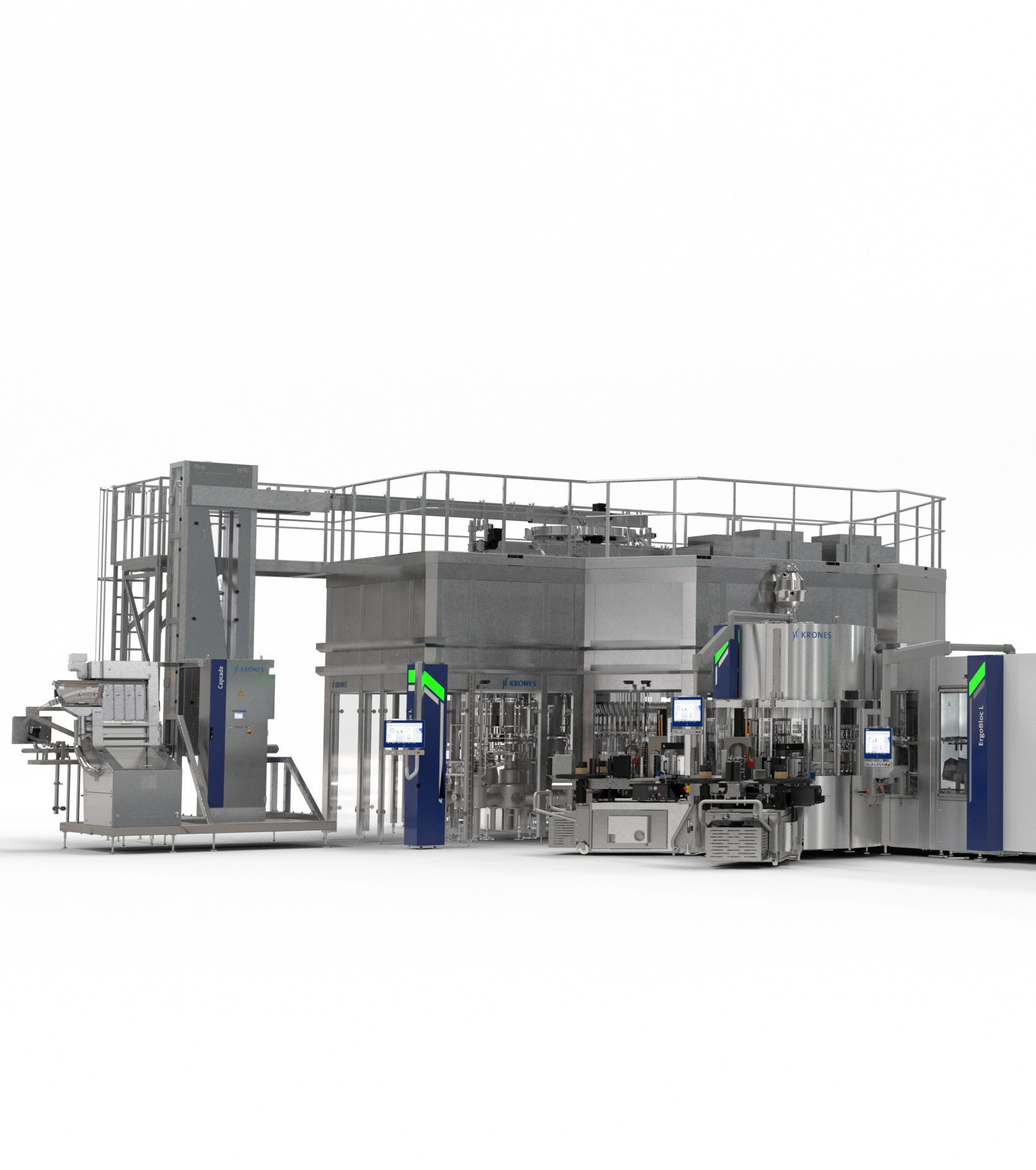
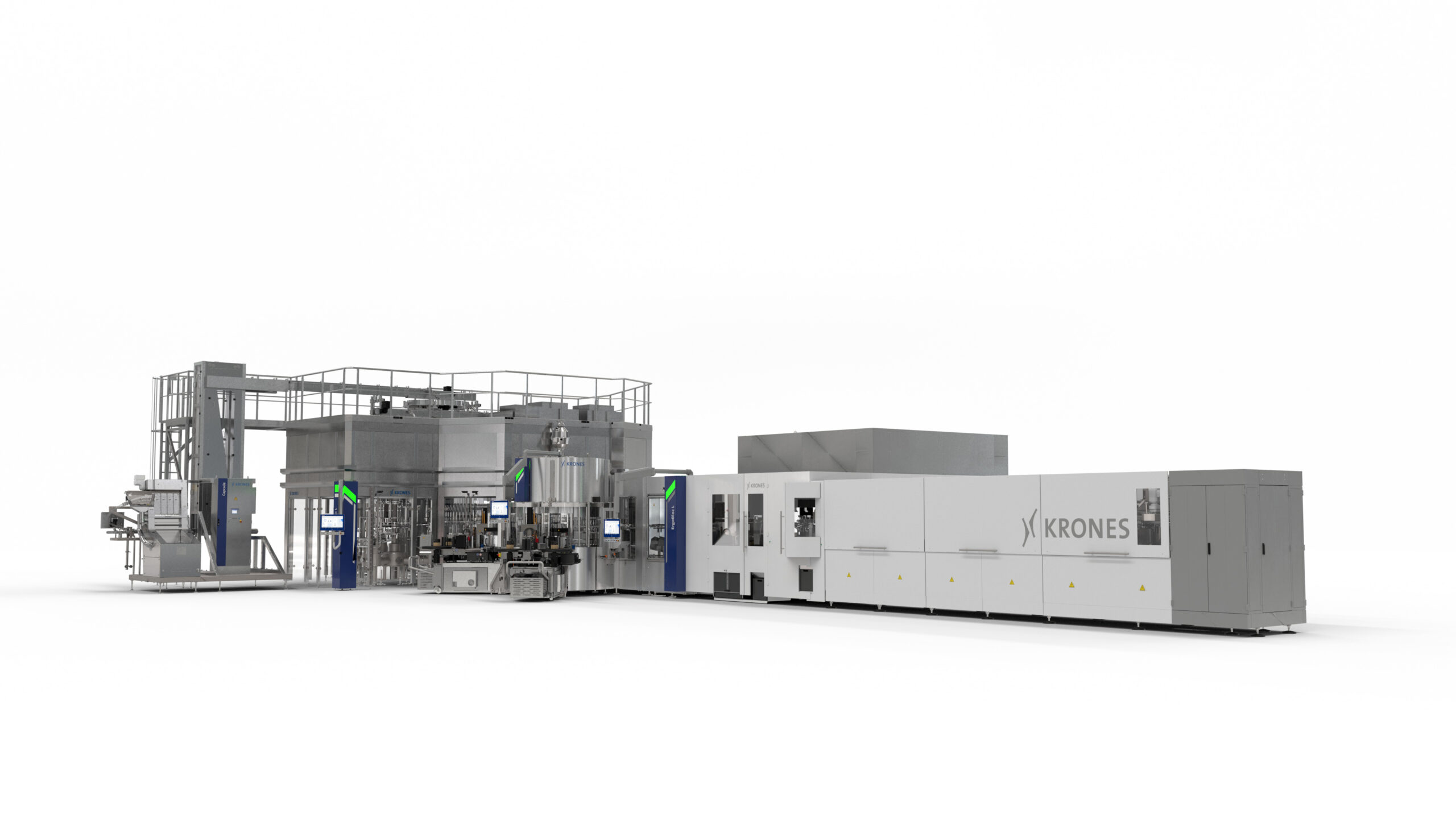
Krones’ response to this development is the world’s first wet-end block achieving an output of 100,000 0.5-litre water bottles per hour thus establishing a new benchmark in block technology.
100,000 Water Bottles in One Hour
The basic production sequence of this 100,000-bph block is just the same as in a conventional ErgoBloc L. But when you take a look at the various individual machines, it soon becomes apparent that there are some key differences.
The preform feed unit passes the PET preforms into the Contiform 3 Speed stretch blow-moulding machine. This machine generation, which was released in 2018, already eliminated the need for a pressure pad to hold the two mould halves together. And with a rating of 2,750 containers per blowing station, it set new benchmarks for output and compressed-air consumption. But in order to raise the total output to 100,000 containers per hour and yet further reduce the machine’s carbon footprint, additional innovations had to be brought into the machine. And that is how some components from the fourth Contiform generation came to be used in this high-performance block.
In order to further improve total cost of ownership (TCO), the fourth generation Contiform uses a newly developed skip-and-run technology, which monitors the mold-hanger locking device and allows a blowing station that is not locked to pass along the main cam, for instance to eject a defective preform without triggering an emergency stop of the entire machine. That considerably reduces the scrap rate and eliminates the need for operator intervention.
When it comes to the development of the new Contiform, one of the paramount goals was an environmentally friendly, sustainable, AND cost-effective operation. The greatest potential for improvement in these areas often lies in reducing energy consumption in preform heating and, of course, in lowering compressed air consumption in the blowing process. And Krones’ R&D team have made the most of these opportunities: They’ve shortened the distance between the heaters, made the heating space even more compact overall, and redesigned the heaters with parabolic reflectors. As a result, they’ve cut energy consumption by 11 percent compared to the previous generation.
The team has also achieved substantial savings on compressed air. Unlike the technology customary on the market to date, the new Air Wizard Triple air recycling system uses a three-stage compressed-air recycling process that can reduce compressed air consumption by as much as 20 percent.
But the focus on sustainability hasn’t been limited to the machine’s operation. It also includes the materials used in the installation process. As an example, the protective panels are made of recycled plastic.